Reflections

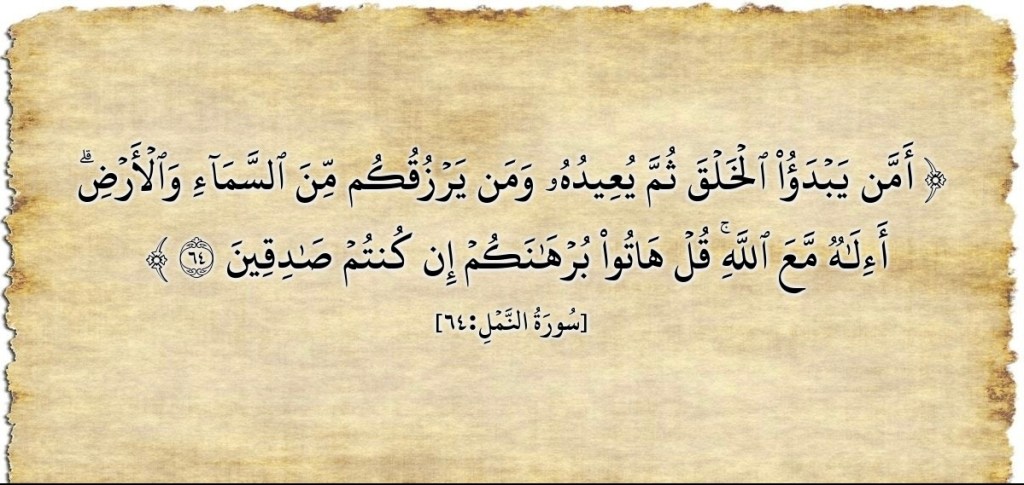
produce your proof if you should be truthful (27:64)

This image has an empty alt attribute; its file name is f111bc3f-2e1a-477f-9d8f-b36db1459e0f.jpeg

When the Prophet (SAW) was sent with the message of ‘no god, but God’ his people did not deny the existence of a creator.

And if you asked them, who sends down rain from the sky and gives life thereby to the earth after its lifelessness? they would surely say, Allah. (29:63)

But though the pre-Islamic Arabs acknowledged His existence and accepted the fact that Allah (SWT) had created the heavens and the earth, they were quite happy to worship idols and were adamant that Allah had no say in how they should manage their affairs on earth.

Really their belief was from the fitrah of Allah upon which He has created [all] people (30:30). The religious instinct is inborn; every human being has been created to feel a need for the Creator, regardless of whether he believes in the existence of the Creator or not. This is why we see man, in all ages and in all parts of the world, practicing some form of religion for he feels comfort and ease when he does so. This feeling of need for Him is awakened when we go through a bad patch or think thoughts that remind us of how weak and mortal we are. This fact is highlighted in the Quran: that though man’s innate nature guides to the belief in the Creator, it is an instinctive emotional response that occurs in the face of a sensed reality.

It is He who enables you to travel on land and sea until, when you are in ships and they sail with them by a good wind and they rejoice therein, there comes a storm wind and the waves come upon them from everywhere and they assume that they are surrounded, supplicating Allah, sincere to Him in religion, If You should save us from this, we will surely be among the thankful. (10:22)

Emotion is ever shifting and thus unreliable. It can lead to misguidance. In the case of the pre- Islamic Arabs, it guided them to associate partners with Allah and to worship idols, all the while believing in the existence of the Creator.

Say, “It is Allah who saves you from it and from every distress; then you [still] associate others with Him.”(6:64)

The Quraysh would supplicate and prostrate before these idols, hoping to be helped by them (36:74); hoping that they will give them power and glory (19:81). To gain closeness to their idols, they would sacrifice animals at their altars and would even dedicate a portion of their crops and cattle to them.

They did all this believing these false gods had the power to intercede on their behalf with God, for Allah is too high for us to gain access to and these idols convey our prayers and petitions to Him.

We worship them only that they may bring us near to Allah. (39:3)

And since their belief came via the emotions, it made it easy for the pre- Islamic Arabs to unquestioningly adopt the worship and way of life of their forefathers.

And when it was said to them Come to what Allah has revealed and to the Messenger, they say, Enough for us is that which we found our fathers following (5:104).

This is what they found their forefathers practicing, and the practices of our fathers and forefathers are good enough for us.

The example of the Quraysh makes clear that when the religious instinct is triggered, man’s innate nature will guide him to feel the existence of the Creator, but if the Aql (intellect) is not used when this instinct is agitated then it can lead to worshipping the Creator and many other things besides. This is why the Quran insists that emotion be tempered by the mind in order to determine the thing that must be worshipped. Only the correct use of the mind will ensure that man worships the One whom the innate nature is guiding to worship, and thereby prevent him from falling into error. 

To this end the Quran repeatedly pushes the pre-Islamic Arabs to examine their belief so that they see the contradictions within and arrive at the correct conclusion. It accuses them of following their own whims and fancies (الظَّنَّ), demanding they produce your proof if you should be truthful (27:64)

The Quran sets out to awaken their rational faculty by drawing their attention to their own acknowledgement that Allah is the Creator and Owner of everything.

To whom belongs the earth and all that lives therein? [Tell me] if you know. (23:84)

They admit Allah is the Owner who has created the earth and all that exists on it.  So, the Quran pushes them,

Will you not, then, reflect? (23:85)

Why do you worship these false gods when you admit that Allah is the Creator of all that exists?

Again, the Quran asks them:

Who is the Lord of the seven heavens, and the Lord of the Supreme Throne? (23:86)

Once again they answer correctly. Allah is the Owner and Ruler of the seven heavens and the Lord of the Mighty Throne. So the Quran rebukes them,

Will you not, then, fear Him? (23:87)

Aren’t you afraid of rebelling against Him, the all-powerful, Lord of the Supreme Throne, who has control over all that is in the heavens, by worshipping such false gods?

And again, the Quran asks them:

In whose hand rests the sovereignty of all things, protecting all, while against Him there is no protection? [Tell me] if you know.’ (23:88)

Once more they accept that Allah is the Supreme Ruler who has power over all things, and from Whom there is no protection. So the Quran reproaches them,

Then how are you deluded? (23:89)

Why then are you so confused and misled? When you know and acknowledge Him to be the Creator, the Owner and the Supreme Ruler of all that is on earth and in the heavens, when you admit none can protect you against Him, then you know that He alone is worthy of worship. So who has bewitched you, into setting up partners with Allah and worshipping them?

The Quran also draws their attention to the fact that their idols, these false gods they worship, are weak and ineffective, incapable of any action that deserves worship:

People, listen to this parable: Those whom you worship instead of God do not have the power to create even a fly, even though all of them would come together for the task. If the fly was to snatch something from them, they would not be able to rescue it from the fly. How feeble are such worshippers and that which they worship. (22:73)

How can these gods who have absolutely no power in the heavens or on earth, who are so feeble that they are incapable of creating even a lowly creature like a fly, who are so powerless that they cannot even protect the offerings which the worshippers bring them daily from being robbed by these flies, be partners of Allah, the Lord of the Supreme Throne. Think!

The Quran time and again underlines the importance of the intellect. Consequently, Islam makes it compulsory that every Muslim should arrive at belief (Iman) in the existence of the Creator by contemplation and reflection so as to ensure that man only worships the One worthy of worship. To this end we find the Quran repeatedly addressing the mind, calling on it to observe and ponder on the creation of Allah so that belief in His existence is based on conclusive evidence. There are countless ayats in the Quran that draw our attention to the heavens and earth, the sun and the moon, the creation of any one of us in our mother’s wombs, even laughter and tears for this very purpose.

Have We not made the earth as a bed, And the mountains as pegs? And We have created you in pairs, And have made your sleep as a thing for rest. And have made the night as a covering, And have made the day for livelihood. And We have built above you seven strong (heavens), And have made (therein) a shining lamp, And have sent down from the rainy clouds abundant water. That We may produce therewith corn and vegetations, And gardens of thick growth. (78:6-16)

And that it is He (Allah) Who makes (whom He wills) laugh, and makes (whom He wills) weep; And that it is He (Allah) Who causes death and gives life;  And that He (Allah) creates the pairs, male and female, From Nutfah (drops of semen male and female discharges) when it is emitted…(53:43-46)

The Quran demands that conviction in the Creator come through looking and thinking deeply upon the creation of Allah so that Iman in Him is absolutely certain (یقین); know that there is no God except Allah (47:19)

In like manner, all the other concepts of Islam, be it belief in the messengers, the books, the angels, the Last Day, or al qadr must also depend on the mind and be based on clear proof. The use of the intellect and having rational evidence to support what we believe, leads to firm conviction and it is this conviction in the aqeedah of Islam that makes it a control for a Muslim’s conduct and what motivates him in his worldly life. On the other hand, if the aqeedah is not based on the intellect and clear evidence but is inherited or taught prescriptively, then it will not give rise to consistent behaviour. In fact it will be easy for Muslims to be affected by many conflicting thoughts and emotions.

We see that the Makkan portion of the Quran is predominantly concerned with belief. For 13 years the Prophet (SAW) taught his followers not only what to believe but also how to arrive at belief.

Jundub ibn Abdullah reported: We were with the Prophet, peace and blessings be upon him, while we were strong young boys. We learned Iman before we learned the Quran…

The Prophet (SAW) used this rational process to teach Iman to his followers, for this is the method of the Quran. His (SAW) utmost care for the Aqeedah and its motivational power is what transformed his followers into remarkable personalities, the Sahabah (ra).

Do they not reflect on the Quran? (4:82)


Iman is “that you believe in Allah and His angels and His Books and His Messengers and in the Last Day, and in qadar, both in its good and in its evil aspects.” (Muslim)

The scholars have defined Iman from the language and the Shariah texts as a firm conviction of the heart, that conforms with the sensed reality based on definite evidence. This means Iman can only be firmly established through the mind and clear evidence.

What are the rational proofs that the Books and Messengers are from Allah ta’aala?

The Quran is a book in the Arabic language. This is a tangible and comprehensible reality. The fact that it is an Arabic discourse allows for only three possibilities for its authorship: an Arab, Mohammad (SAW) who proclaimed it, and Allah ta’aala.

The Quran could not be from the Arabs because it challenged them to bring something similar,

Let them then produce a recital like unto it (the Quran) if they are truthful. (52:34)

Say, Then bring ten surahs like it… (11:13)

then bring a single surah like it…(2:23)

The Arabs were unable to meet the challenge of the Quran. The number of reports from the 7th century that attest to this has the status of ‘tawaatur’ (recurrent chains of reporting that are beyond any doubt.)

Yet historians affirm that the time of the Quran’s revelation was the golden age of Arab eloquence. The 7th century Arabs were masters of the Arabic language, revered poetry and had amongst them the best poets and orators. They were well equipped to meet the challenge of the Quran. If they had succeeded it would have proved the Quran to be the speech of a human being. They not only failed, but found themselves captivated and perplexed by its unique composition and eloquence. Waleed bin Mughira, one of the leaders of Quraysh and a poet said,

‘By Allah, I have heard a speech from Muhammad (Quran) that is neither from the speech of men or jinn; the top of it is fertile and beautiful, it has a rhythm and it surpasses everything I’ve heard and nothing can surpass it.’

This also proves that the Quran could not have been Mohammad’s (SAW) speech, for after all he was an Arab. If the Arabs were incapable, then as an Arab he too was incapable. And if it had been his speech then any of his contemporaries would have been able to rival it. In fact Mohammad (SAW) was known to have never composed or recited any poetry; he never studied under a poet master nor competed in the annul poetry competitions that were held at Souk Ukaz. Consequently, it is rationally impossible to believe that the Quran could be the speech of Mohammad if the acknowledged masters of poetry were incapable of meeting the challenge.

Moreover, Mohammad (SAW) never claimed that the Quran was his speech nor did the Arabs allege that it was.

Since the Quran is neither the speech of the Arabs nor of Mohammad, then the only rational explanation is, that if is from Allah ta’aala,

And truly, this (the Quran) is a revelation from the Lord of the ‘Alamin (mankind, jinns and all that exists) (26:192)

The Quran is also the rational proof of Mohammad’s Messengership. We know through recurrent reports that Mohammad (SAW) brought the Quran. Allah ta’aala supported His Prophets with miracles so as to prove the truthfulness of their claim. The Quran is the miracle of Prophet Mohammad (SAW) for he challenged his people with it and they were incapable of meeting the challenge: A miracle and challenge that will endure till the Day of Judgement.

“Every Prophet was given miracles because of which people believed, but what I have been given, is Divine Inspiration which Allah has revealed to me.” (Sahih Bukhari).

Moreover, the Quran is the divine law of Allah which only the Messengers brought, further proof of Prophet Mohammad’s Messengership.

As for Iman in the other Books of Allah and the Messengers who brought them, Iman in them is not rational, for the miracles that prove their truthfulness can no longer be sensed. Musa’s (as) staff turning into a snake, and Isa (as) bringing the dead back to life, are miracles that have ceased to exist. However, we believe in these miracles, the Books and the Messengers who brought them because they have been mentioned in the Quran or mutawatir Hadith. So while it is true we have no rational evidence that these Books and Messengers are from Allah, Iman in them is not ‘blind’. This is because Iman in them is based on our rationally proving that the Quran is the Speech of Allah ta’aala.

Say, (O believers),We have believed in Allah and what has been revealed to us and what has been revealed to Abraham and Ishmael and Isaac and Jacob and the Descendants and what was given to Moses and Jesus and what was given to the prophets from their Lord. We make no distinction between any of them, and we are Muslims (in submission) to Him. (2:136)

This is also why we have Iman in the angels, the jinn, the Last Day, Reckoning, Paradise, Hellfire, and Al Qadr. None of these things can be perceived by our senses, but because our Aql has acknowledged the reality of a Creator, and accepted the Quran as His speech, we have Iman in all that is disclosed to us by Allah ta’aala and the Rasool (SAW).

O you who have believed, believe in Allah and His Messenger and the Book that He sent down upon His Messenger and the Scripture which He sent down before. And whoever disbelieves in Allah , His angels, His books, His messengers, and the Last Day has certainly gone far astray. (4:136)

‘And We have indeed sent a Messenger to every Ummah…’ (16:36)


Can you conclusively answer any of the questions below without divine messengership:

1. Who is my Creator? What is His nature and attributes? The Arabs of Makkah wanted to know if He (SWT) was made of gold, silver or iron. Christians believe God has a son. Hindus think God can take many forms- male, female or both. They also believe that in order to communicate with God, idols are needed, a purpose served by dead ancestors in some African cultures. Who is right? While we can rationally perceive the existence of Allah through his creation, Allah’s being is beyond what our senses can perceive and so beyond the reach of human reason. It is only through the messengers that we are able to know the nature and attributes of Allah ta’aala

2. Is there a purpose to my existence? or is life purposeless? are we here to eat, work, mate, sleep, repeat? or is life all about the pursuit of pleasure and happiness? or is the purpose the pursuit of wealth and security? How can I know with any degree of satisfaction why I exist? Without communication from the Creator, Allah ta’aala, we could argue and counter argue the purpose of our existence endlessly, without reaching a definite conclusion.

3. How do I worship the Creator? Each one of us is born with the religion instinct. It has been programmed within us to sanctify and worship.The Christians sing hymns. Hasidic Jews see dance as prayer and communicate with God through ecstatic dancing meant to induce a mystical state. Every morning Hindus awaken their idol by lighting a diva, and then proceed to wash, dress, garland, and make offerings of food to their idol. Some seek closeness to God by adopting an ascetic lifestyle, giving up material possessions and physical pleasures to purify the soul. Which way is correct? It is not possible for humans, relying on their intellect, to know the correct manner of worship. A fact Zaid bin Amr bin Nufail, who lived in Makkah before the advent of Islam, but who rejected idol worship, recognised. He would say,

‘O Allah! Only if I knew Your desired way of worship so that I could worship you in that manner. However, I am unaware of it.’

4. What happens to me after I die? ‘When we die and become dust and bones, shall we then indeed be raised up again?’ (56:47) Will our actions be judged? Is there a Day of Judgement? Do Heaven and Hell exist? The human mind is limited and cannot perceive what lies beyond the senses. Thus, man cannot grasp with any certainty the afterlife . Only Allah (SWT) through the messengers can provide us with this knowledge.

5. Who decides the correct manner of satisfying our organic needs and instincts? The Creator has created humans with specific organic needs and instincts. He (SWT) has also inspired us to act to satisfy these needs and instincts. We can see that when man uses his intellect to come up with a system to regulate these needs and instincts, it leads to misery. In the West, cohabitation, rising divorce rates, premarital sex, teen pregnancy, rise in single parent households, same sex marriages are all due to the fact that there is an incorrect system in place to satisfy the procreation instinct. Not only is misery the outcome, but the laws framed by man to satisfy these organic needs and instincts are prone to bias, contradictions and inconsistencies. So today, homosexuality and cohabitation are legal, but not so long ago these were criminal offences. What’s changed? Who decides?

Only Allah (SWT) who has created us with these organic needs and instincts can provide us with a correct system for their satisfaction: a system free from bias and contradictions, and one not influenced by changing trends and the environment. Only the messengers can transmit to us this knowledge from Allah ta’aala.

6. Who decides what is good or bad, right or wrong? Do we give certain individuals this right? We can see that setting ethical boundaries is entirely subjective, influenced by any number of things such as gender, nationality, race, education, environment. Man is unable to agree on what should be praised and shunned, what should be legal and illegal. In fact any viewpoint can be justified. Today as the West acknowledges institutional racism and with homosexuality being rammed down our throats, it begs the question, does man have the capability to decide what is good or bad?

Only Allah ta’aala is the unquestionable authority that can provide us with the knowledge of right and wrong; a guidance free from bias and contradictions.

Clearly, man with his limitations is unable to provide conclusive answers to these questions, only Allah ta’aala can. The answers make evident that only Allah (SWT) can provide a correct system to organise man’s relationship with Him and to regulate his life affairs. Allah (SWT) chose to communicate with us and guide us through the messengers,

‘And We have indeed sent a Messenger to every Ummah (community, nation)…’ (16:36)

‘I call on Allah with sure knowledge…’ (12:108)

As children we are taught the 6 articles of Iman,

“that you believe in Allah and His angels and His Books and His Messengers and in the Last Day, and in qadar, both in its good and in its evil aspects.” (Muslim)

What we are not taught, is the way in which we are meant to attain Iman. Yes, there is a process to Iman.

The scholars have defined Iman from the language and the Shariah texts as an irrefutable conviction that is deeply rooted in the heart. They also agree that Iman must comply with the sensed reality and be based on evidence. What does this mean?

This means that Iman is not something you are born into nor is it handed down from father to son, nor is it blind, unsubstantiated belief, nor can it be based on speculation or imitation. Rather belief in the fundamental tenets of faith must result from clear evidence. This evidence is either rational if the tenet to be proved can be sensed via the senses (e.g belief in Allah) or rational in origin, if it is inaccessible to the senses, but it comes via a source that has been intellectually confirmed (e.g belief in the angels). It is having evidence for belief that leads to conviction.

The Quran spends a great deal of time clarifying the correct path to Iman.

It tells us Iman cannot be based on guesswork,

And because of their saying: We slew the Messiah, Jesus son of Mary, Allah’s messenger… they have no knowledge thereof save pursuit of a conjecture; they slew him not for certain. (4:157)

‘Verily, those who believe not in the Hereafter, name the angels with female names.While they have no knowledge thereof. They follow but a guess, and verily, guess is no substitute for the truth.’ (53:27-28)

It cannot be inherited from our forefathers,

And when it is said to them, “Come to what Allah has revealed and to the Messenger,” they say, “Sufficient for us is that upon which we found our fathers.” Even though their fathers knew nothing, nor were they guided? (5:104)

And We had certainly given Abraham his sound judgement before, and We were of him well-Knowing. When he said to his father and his people: “What are these images, to which you are devoted? They said:”We found our fathers worshipping them.” He said: “Indeed you and your fathers have been in manifest error.” (21:51-54)

It cannot be based on our whims and desires,

And they say: “None shall enter Paradise unless he be a Jew or a Christian.” Those are their (vain) desires. (2:111)

They are but names which ye have named, ye and your fathers, for which Allah hath revealed no warrant. They follow but a guess and that which (they) themselves desire.(53:23)

Rather Iman must be based on irrefutable evidence,

Say: I only follow what is revealed to me from my Lord; these are clear proofs from your Lord and a guidance and a mercy for a people who believe. (7:203)

These people of ours have taken for worship deities other than Him, without being able to show any convincing proof of their beliefs. Who does more wrong than he who invents a lie about God? (18:15)

Is He [not best] who begins creation and then repeats it and who provides for you from the heaven and earth? Is there a deity with Allah? Say, “Produce your proof, if you should be truthful.” (27:64)

without solid evidence, it is mere fabrication,

And they have no knowledge thereof. They follow but a guess, and lo! a guess can never take the place of the truth.(53:28)

To this end, the Quran repeatedly insists we make use of our intellect (عَقْل) to arrive at belief in Allah t’aala. From the very first word revealed to Prophet Mohammad (SAW) ‘read’ (ٱقْرَ), to countless ayaat that urge us to ‘think deeply about the creation of the heavens and the earth’ (3:110), to ‘look at the signs of Allah’s mercy’ (30:50), to ‘contemplate within themselves’ (30:8), the Quran awakens our mind to the signs of Allah in the created universe, so that our Iman is rooted in observation and critical thinking.

The evidence of the existence of the Creator is exhibited in every single thing around us. When we look towards ourselves and at everything else in the universe, we observe that everything is subject to limitations: everything that we perceive ultimately dies; nothing is self-sustaining; we all have limited physical qualities (shape, size, colour, height, temperature, volume etc.) that we did not ascribe to ourselves; none of us have a choice in the matter of our birth or death; we are all incapable of creating from nothingness.

Indeed the Quran repeatedly pushes us to observe how limited we and everything around us is. Thus do we expound arguments to point the way to reality for the people of understanding. (30:28),

How dare you deny the existence of God Who gave you life when you initially had no life. He will cause you to die… (2:28)

Say: Have you considered: if Allah should take away your hearing and your sight and set a seal upon your hearts, which deity other than Allah could bring them [back] to you? (6:46)

Or, Who has created the heavens and the earth, and Who sends you down rain from the sky? Yea, with it We cause to grow well-planted orchards full of beauty of delight: it is not in your power to cause the growth of the trees in them. (27:60)

Say: Have ye thought: If (all) your water were to disappear into the earth, who then could bring you gushing water? (67:30)

Say: Have you considered: if Allah should make for you the night continuous until the Day of Resurrection, what deity other than Allah could bring you light? Then will you not hear? (28:71)

Say, [O Muhammad], “Have you considered that which you invoke besides Allah? Show me what they have created of the earth; or did they have partnership in [creation of] the heavens? (46:4)

O mankind! A similitude has been coined, so listen to it (carefully): Verily! Those on whom you call besides Allah, cannot create (even) a fly, even though they combine together for the purpose. And if the fly snatched away a thing from them, they would have no power to release it from the fly. So weak are (both) the seeker and the sought.(22:73)

All these limitations, which have been imposed on us and over which we have no control attest to the fact that we are all created, and so there has to be an external source responsible for creating everything. This source is Allah ta’aala, who it follows must be eternal and independent, for if He was limited then He too would be created by someone and thus not the Creator. Allah ta’aala’s existence is inevitable for all things depend on Him for their existence.

The Quran is relentless in trying to awaken the human mind, pushing it to think and arrive at this conclusion,

Have they been created from nothing or are they themselves their own creators? Or did they create the heavens and the earth? … (52:35-36)

We know out of nothing comes nothing, things come to be because something or someone made them happen. We know we did not create ourselves. Nor are we capable of creating the heavens or the earth.

Again and again the Quran draws our attention to the fine-tuned universe and everything within it, urging us to reflect on its complexity, vastness and beauty, so that Iman in Allah ta’aala is arrived at through reason,

Indeed, in the creation of the heavens and earth, and the alternation of the night and the day, and the [great] ships which sail through the sea with that which benefits people, and what Allah has sent down from the heavens of rain, giving life thereby to the earth after its lifelessness and dispersing therein every [kind of] moving creature, and [His] directing of the winds and the clouds controlled between the heaven and the earth are signs for a people who use reason. (2:164)

Do you not see that Allah causes the night to enter the day and causes the day to enter the night and has subjected the sun and the moon, each running [its course] for a specified term (31:29)

He created the heavens without any pillars that ye can see; He set on the earth mountains standing firm, lest it should shake with you; and He scattered through it beasts of all kinds. We send down rain from the sky, and produce on the earth every kind of noble creature, in pairs. (31:10)

And lo! in the cattle there is a lesson for you. We give you to drink of that which is in their bellies, from betwixt the refuse and the blood, pure milk palatable to the drinkers. (16:66)

And on the earth are signs for those who have Faith with certainty, And also in your ownselves. Will you not then see? (51:20-21)

So let man see from what he is created! He is created from a water gushing forth proceeding from between the back-bone and the ribs (86:5-7)

And of His signs is your sleep by night and day and your seeking of His bounty. Indeed in that are signs for a people who listen. (30:23)

It is sufficient to draw our attention to anything within the universe to prove the existence of Allah ta’aala.

Now it is true that belief in the Creator is innate in every man. The Prophet (SAW) said, ‘Every child is born in a state of fitrah…’(Bukhari)

But this innate awareness of the Creator is due to the religious instinct which has been created in man and is triggered when we feel weak and needy,

Say, Who rescues you from the darknesses of the land and sea [when] you call upon Him imploring [aloud] and privately, ‘If He should save us from this [crisis], we will surely be among the thankful.’ (6:63)

And when harm touches men, they cry sincerely only to their Lord (Allah), turning to Him in repentance…(30:33)

If man were to respond to this agitation of the religious instinct, without using the mind, it can lead to error and the worship of others thought to be worthy of worship, all the while acknowledging the existence of the Creator. 

And when they board a ship, they supplicate Allah , sincere to Him in religion. But when He delivers them to the land, at once they associate others with Him (29:65)

For this reason, emotion on its own, is an unreliable path to Iman. Idol worship, mythology, anthropomorphism, and giving divine attributes to human beings are just some examples of mistakes that occur when one relies on emotion alone. This is why Islam obligates that emotion be tempered by the mind so that man only worships the One whom the innate nature is guiding to.

Every muslim must come to Iman in Allah ta’aala through conscious, rational reflection based on what we can sense and observe, so that Iman in Him (SWT) is absolutely certain.

I call on Allah with sure knowledge… (12:108)

‘a chicken can never lay a duck egg’

‘…Whoever heard of a sociological explosion that was done intelligently and politely? And this is what you’re trying to make the Black man do. You’re trying to drive him into a ghetto and make him the victim of every kind of unjust condition imaginable. Then when he explodes, you want him to explode politely!’ (Malcolm X at the London School of Economics, Feb. 11, 1965)

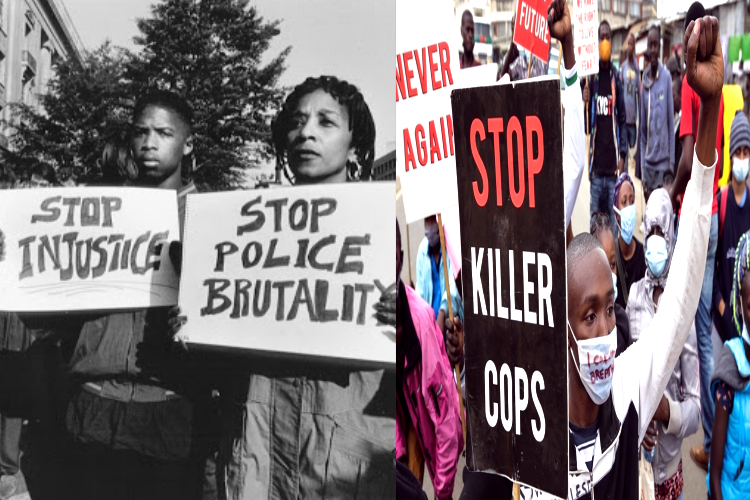
With the recent ‘race riots’ in America, sparked by the killing of George Floyd, being compared to the ‘long, hot summer riots of the 1960’s’, I felt compelled to re-read the autobiography of Malcolm X. 

Perhaps I was looking to be reminded…how a country that advocates to be the champion of justice and upholder of human rights, can have a long history of racial injustice.

Malcolm X’s autobiography is not only his life story, but a social and political indictment against the American system of life.

Even at four years old Malcolm X, is aware of racism. His ‘earliest vivid memory’ is of

‘ being suddenly snatched awake into a frightening confusion of pistol shots and shouting and smoke and flames. My father had shouted and shot at the two white men who had set the fire and were running away. Our home was burning down around us…I remember we were outside in the night in our underwear, crying and yelling our heads off. The white police and firemen came and stood around watching as the house burned down to the ground…After the fire, I remember that  my father was called in and questioned about a permit for the pistol…’ (The Autobiography of Malcolm X)

Though he grows up in the north of America considered to be ‘free’ in contrast to the ‘unfree’ South, nothing could be further from the truth.‘I am a creation of the Northern white man and of his hypocritical attitude toward the Negro,’ he said

The north already had desegregated lunch counters, desegregated parks and theatres, desegregated public toilets. As Malcolm X mocked,

‘you can sit down next to white folks on the toilet. Imagine that!’

But though the blacks had equality on paper, due to the color of their skin they could go just so far and no further. They lived, hemmed in central cities, in ghettoes (think shanty towns in third world countries), because the white man did not want to live next door to them; filthy ghettos where their babies were in danger of being bitten by rats; theoretically they could go to a white man’s restaurant, but they had no money for a meal in a white man’s restaurant; their people died daily from ‘that dreadful needle- heroin, morphine, cocaine, opium.’

Malcolm X came to be known as ‘the angriest black man in America’ for exposing the true face of American capitalism. ‘I would become so choked up, he said, that sometimes I would walk in the streets until late into the night. Sometimes I would speak to no one for hours, thinking to myself about what the white man had done to our poor people here in America.’ He was committed to telling the truth, ‘speaking as a victim of this American system’, so that his people could know who the enemy was in their struggle for dignity.    

‘Twice as much rent is paid for rat-infested, roach-crawling, rotting tenements. This is true. It costs us more to live in Harlem than it costs them to live on Park Avenue…And in Harlem you have everything else in that apartment with you—roaches, rats, cats, dogs…’ (OAAU Founding Rally June 28 1964)

‘ And the white merchants charge us more money for food in Harlem—and it’s the cheap food, it’s the worst food; and we have to pay more money for it than the man has to pay for it downtown.’ (After the firebombing February 14 1965)

The majority of blacks were either underemployed, ‘doing the dirtiest jobs for the lowest pay’, or unemployed, forcing many people into a life of crime. The ghetto was a place of pimps and prostitutes, drug pushers and addicts. A place of black on black crime, white hostility, and police brutality. ‘I think that an objective reader may see how in the society to which I was exposed as a black youth here in America, for me to wind up in prison was really just about inevitable.’ Malcolm’s description of his life in the ghetto shows what white society did (and still does) to those who are its black victims.

His book unmasks an inhumane and intolerant society that ‘will crush people and then penalize them for not being able to stand up under the weight.’ A society for whom integration meant ‘tokenism’ ‘one or two negroes in a job, or at a lunch counter, so the rest of you will be quiet’ or ‘ handouts in the form of appointments that are only used as window dressing to make it appear that the problem is being solved.’

Not surprisingly, he persistently warned of the imminent explosion of ‘America’s racial powder keg.’ Malcolm X could see that the new generation of blacks were fed up of ‘turn the other cheek and heaven after you die philosophy.’ He counseled that the black man had a right to protect their women and children in the face of increasing white attacks; they had a right to their basic necessities right here on earth, rather than look to heaven for a better life. He saw it as a ‘miracle’ that 22 million black people ‘have remained a peaceful people, while catching all the centuries of hell that they have caught, here in white man’s heaven!’ They were impatient with police dogs and clubs, with water hoses and tear gas. They had had enough with the lynching, the abuse, the exploitation, enough with the lack of respect and dignity. ‘And in this country the black can be fifty years old and he is still a “boy.” In this society we remain ‘boys’.

1964 will be America’s hottest year; her hottest year yet; a year of much racial violence and much racial bloodshed. But it won’t be blood that’s going to flow only on one side. The new generation of black people that have grown up in this country..are already forming the opinion…that if there is to be bleeding, it should be reciprocal-bleeding on both sides…Negroes have done nothing but seen each other turn the other cheek. This generation won’t do it, won’t do it any longer…

An example of this was taking place last night at this same time in Cleveland, where the police were putting water hoses on our people there and also throwing tear gas at them—and they met a hail of stones, a hail of rocks, a hail of bricks. Now, Negroes didn’t do this ten years ago… The seriousness of this situation must be faced up to. You should not feel that I am inciting someone to violence. I’m only warning of a powder-keg situation…’ (The Black Revolution April 8 1964)

Malcolm X understood that the oppression his people were subjected to and were rising up against was not because of a few bad apples, but was systematic, grounded in the makeup of the American political, economic and social order. ‘You can’t have capitalism without racism’; ‘you have to have someone else’s blood to suck to be a capitalist.’ He argued that the system could not produce freedom and equality for Black people, in the same way that a ‘chicken can never lay a duck egg’. The best the Afro-American could hope for was ‘token integration’, where a lucky few did well but the masses were locked out. 

‘A man or system which oppresses a man because of his color is not moral…It’s the system that is rotten; we have a rotten system. It’s a system of exploitation, a political and economic system of exploitation, of outright humiliation, degradation, discrimination—all of the negative things that you can run into, you have run into under this system…’ (OAAU founding Rally June 28 1964)

‘And there is no system on this earth which has proven itself more corrupt, more criminal, than this system that in 1964 still colonizes 22 million African-Americans, still enslaves 22 million Afro-Americans.’ (The Black Revolution April 8 1964)

He concluded that the only way out was ‘black nationalism’. He urged blacks to unite and separate themselves completely from whites, so that they could either return to their African homeland or build a separate black nation in the Western Hemisphere.

However, when he journeys to Makkah for the Hajj pilgrimage and becomes a Muslim, Malcolm X sees that there is a way the black and white man can live together on earth. He realises there is a ‘proven solution’,

‘America needs to understand Islam, because this is the one religion that erases from its society the race problem.Throughout my travels in the Muslim world, I have met, talked to, and even eaten with people who in America would have been considered ‘white’— but the ‘white’ attitude was removed from their minds by the religion of Islam. I have never before seen sincere and true brotherhood practiced by all colors together, irrespective of their color.’

What he had been searching for, for his people, for them to be respected as human beings, for them to have access to basic material needs, for them to have a right to education and employment, he found to be an inalienable right of all in Islam. Islam spoke to the whole person – to the economic, social, political and spiritual wellbeing of not only blacks, but of every human being.

How does Islam speak to the whole person?

The system of life that Allah (SWT) has chosen for man ensures justice and dignity of all mankind. Allah (SWT) sent Prophet Muhammad (SAW) ‘as a mercy to the worlds’ (21:107); a mercy because he brought a law that taught humans how to live harmoniously with each other. The Prophet (SAW) founded a state in Madina on these revealed laws, and as Islam spread, the Islamic State managed to meld and unite people of various nations, colors, and religions.

Managing people with all their differences and complexities did not constitute a problem for the Muslim Ummah as it was guided by the Book and Sunnah of Allah (SWT).

Allah teaches us that regardless of our skin colours and physical traits, inspite of the diversity of our cultures and languages, we are all the children of Adam. He (SWT) has ‘created you from one soul (Adam), and from him, He created his wife (Hawwa), and from them both He created many men and women’ (4:1). Allah also tells us that ‘We created man out of an extract of clay (water and earth), then We made him as a Nutfah (mixed drops of the male and female sexual discharge) (and lodged it) in a safe lodging (womb of the woman); then We made the Nutfah into a clot, then We made the clot into a little lump of flesh, then We made out of that little lump of flesh bones, then We clothed the bones with flesh, and then We brought it forth as another creation. So blessed be Allah, the Best of creators’ (23:12-14). And we come in different colours because,

‘Verily, Allah Almighty created Adam from a handful which He took from the earth, so the children of Adam come in accordance with the earth. Some come with red skin, white skin, or black skin, and whatever is in between: thin, thick, dirty, and clean.’ (tirmidhi)

Allah has even informed us that He has divided us into nation and tribes ‘so that you may know one another’ (49:13); so that we can cooperate and help each other to meet all our various needs.

All of this human diversity is in fact a sign of Allah’s existence and power; and can not be taken to mean that a particular nation or color is superior or inferior. The Prophet (SAW) has clarified to us,

‘An Arab is not better than a non-Arab and nor a non-Arab is better than an Arab, and a White man is no better than a Black man, nor a Black man is better than a White man…’ (Ahmad)

Rather Islam teaches that superiority is only on the basis of God consciousness; ‘Indeed, the most noble of you in the sight of Allah is the most righteous of you’ (49:13), for ‘verily, Allah does not look at your appearance or wealth, but rather He looks at your hearts and actions.’ (Muslim)

It was this concept and Islam’s insistence on equality of every member of the human race, the ‘colour blindness’ of the Muslim world, that revolutionalized the way Malcolm X thought. He was shocked when he went to Makkah and saw pilgrims who ‘were of all colors, from blue-eyed blonds to black skin Africans…displaying a spirit of unity and brotherhood that my experiences in America had lead me to believe never could exist between the white and non-white.’ He moved away from seeing the white man as ‘inherently evil’, to understanding that ‘it’s the American political, economic and social atmosphere that automatically nourishes a racist psychology in the white man.’ Sadly today we see the Muslim world becoming more and more divided along these divisive lines as a result of our capitalistic economies.

Allah’s laws do not only deliver social justice but economic justice too. Allah tells us that He (SWT) has ‘honoured the Children of Adam…and exalted them above many of Our other creatures’ (17:70), so Islam seeks to maintain man’s dignity by providing a satisfactory standard of living for every individual. Because how can man, the noblest creation of Allah, whom Allah has ‘exalted’, satisfy his spiritual yearnings and his intellectual abilities, if he spends his whole life worrying about making ends meet? Such a society, where people are not able to earn a sufficiency, is disobedient to the will of Allah.  

So the Islamic economic system seeks to secure the basic needs- food, clothing and shelter- completely of every single citizen of the Islamic State. The Prophet (SAW) said ‘the son of Adam has no better right than that he would have a house wherein he may live, a piece of clothing whereby he may hide his nakedness and a piece of bread and some water’ (tirmidhi)

The State does this by providing job opportunities so that every capable person can work and acquire the basic needs for himself and his dependents, ‘He it is Who has made the earth subservient to you; so walk in the paths thereof and eat of His provision’ (67:15), and the Prophet (SAW) said, ‘No meal eaten by one of you is better than the meal he eats from the work of his own hands. (bukhari)

For those who cannot earn or whose families cannot provide for them, it is the State’s responsibility- ‘the ruler is the supporter of he who has no supporter’ (abu Dawud)- to provide for them from the Zakat in order to fulfil their bodily needs and preserve their dignity. Through the payment of Zakat, which Allah has made obligatory on all those who possess wealth that they should pass on to the needy some part of it, ‘And those in whose wealth there is a known right, For the beggar and the destitute’ (70:24-25), Islam achieves not only an equitable distribution of wealth ( ‘So that this wealth should not become confined only to the rich amongst you’ (59:7), but also fosters a sense of harmony amongst the members of society.

Islam ensures these social and economic rights are upheld by both relying on the system of law and appealing to the human conscience. The Prophet (SAW) has told us that ‘the Imam (ruler) is a guardian and is responsible for his subjects’ (bukhari), so it is his duty to make certain that all citizens, including non-muslim citizens, are granted their rights and live in a just society. Allah (swt) says, 

‘And if you judge, judge with justice between them. Verily, Allah loves those who act justly.’ (5:42)

‘O you who believe! Stand out firmly for justice, as witnesses to Allah, even though it be against yourselves, or your parents, or your kin, be he rich or poor…'(4:135)

At the same time Islam appeals to the human conscience making it responsible for complying with all laws and duties ordained by Allah. The Quran and injunctions of the Prophet (SAW) foster a firm conviction that Allah sees all and knows all ‘Fear Allah for Allah knows the very secrets of the hearts’ (5:7), instilling in the believer the belief that he is accountable for his actions, an accounting that will lead to heaven or hell.

The Islamic system of life is not from the minds of men, rather it is from the Creator of all Mankind. A man made system of life will no doubt lead to the oppression of people. Only a system from the Creator, who knows all the rights that man is entitled to and how these rights should be administered, can provide justice for all. Is it any surprise than that Malcolm X said, Islam ‘is the one religion that erases from its society the race problem.’

‘Lo! We revealed it on the Night of Power’ (97:1)

Abu Huraira reported that the Messenger of Allah (SAW) said,

Whoever stands (in qiyaam) in Laylatul-Qadr out of faith and expectation (of Allah’s reward), will have all of his previous sins forgiven. (Bukhari)

And so we intensify our ibadah in the last ten nights especially the odd nights, hoping for forgiveness, hoping to increase our record of good deeds.

We make this night so much about ourselves… my dua (دُعَاء‎ ), my dhikr (ذِكْر‎) , my forgiveness (استغفار), that we lose sight of what really happened on this night.

Lo! We revealed it on the Night of Power. (97:1)

This was the night in which Prophet Mohammad (SAW) started to receive

the Qur’an, a guidance for mankind, and clear proofs of the guidance, and the Criterion (of right and wrong). (2:185)

a Guidance that ordered Mohammad (SAW) to Arise and warn, Thy Lord magnify (74:2-3) : ordering him to proclaim the greatness of Allah, the real Sovereign of the world,

a Guidance that made plain that the One Whom his people acknowledged to be the Creator of them and all that exists, the One Whom they knew to manage and sustain all life, the One whom they called Allah, is their Lord (رب), and ordered them to discard their chiefs and elite, whom they had wrongfully magnified and elevated to the position of رب

Lo! your Lord is Allah Who created the heavens and the earth in six Days, then mounted He the Throne. He covereth the night with the day, which is in haste to follow it, and hath made the sun and the moon and the stars subservient by His command. His verily is all creation and Sovereignty. Blessed be Allah, the Lord of the Worlds! (7:54)

a Guidance that made clear the meaning of life and the purpose of man’s existence; and made distinct the right path from the wrong

And I did not create the jinn and mankind except to worship Me. (51:56)

Did We not command you to worship Me and tell you that this is the right path? (36:61)

a Guidance that henceforth started a movement that intellectually challenged the false beliefs and decadent lifestyle of Makkan society, seeking to eliminate all human lordship and establish the Lordship of Allah,

It is He Who has sent His Messenger with guidance and the deen of truth, to make it superior over all other deens even though the Mushrikun hate (it). (9:33)

a Guidance that enabled the Prophet (SAW) to establish a state in Madina that governed the affairs of people by the Laws of Allah and was the means of conveying Islam to the world. Its establishment was a culmination of what had been gifted to him (SAW) on the Night of Power; what Sayyid Qutb in his tafsir of this Surah eloquently describes as

‘ real happiness and peace… namely, the peace of conscience, family and society.’

SubhanAllah, on these last ten blessed nights we have to remind ourselves of the tremendous event that took place on the night of Laylatul-Qadr and how it transformed a group of people into a nation that sought to establish Allah’s authority and justice over the entire earth. We need to reconnect with how the Prophet (SAW) and the Sahabah approached the Quran so that we too,إِنْ شَاءَ ٱللَّٰهُ‎, can reach our full potential.

رِجْزًا مِّنَ ٱلسَّمَآءِ

Perhaps the most well kept of secrets, from the Muslim Ummah today, is the purpose behind its creation.

‘We have made you the (أُمَّةً وَسَطًا ) just and best nation, so that you may be witnesses [to the Truth] before all mankind, and the Messenger may be witness [to it] before you (2: 143).

The Quran tells us that this Ummah was raised up by Allah (SWT) to discharge a specific duty, to be ‘witnesses (to the Truth) before mankind.’ What does this mean? It means that in our person, we look Muslim and act Muslim and as an Ummah we live under Allah’s Sharia and invite the rest of mankind to live by this guidance too. This position of being witness to the truth before all mankind amounts to the Muslim ummah being vested with the leadership of mankind. But to take on this role the Ummah must first establish a state ruled by Allah’s law, that then proceeds to convey Islam to the rest of mankind so that Allah’s Deen prevails over all other systems of life. Not many of us know that this duty has the status of a covenant with Allah.

To prepare the Ummah for shouldering this heavy duty, Allah (SWT) in His infinite Mercy, provides us with the example of Bani Israel. They were the Muslim Ummah before ours. Allah (SWT) brings Bani Israel alive for us in the pages of the Quran, so that we can learn from their example.        

 Like our Ummah they too had been chosen,

‘O Children of Israel! Remember My favor wherewith I favored you and how I preferred you to (all) creatures.’ (2:47)

Allah (SWT) ‘preferred’ them over all of mankind to receive His guidance, to live by it and to invite others to live by it. But they ended up breaking their covenant with Allah,

‘And (remember) when We took your covenant and We raised above you the Mount (saying), Hold firmly to what We have given you and hear (Our Word). They said, We have heard and disobeyed.’  (2:93)

One episode of their history, in particular, lingers in the mind; no doubt for its topical overtones. When the Children of Israel finally manage to conquer the city of Jerusalem, Allah commands them to enter the gates of the city prostrating in humility, thankful to Allah for their victory saying ‘Hittah’: relieve us of our sins. But they enter the city creeping on their behinds, rather than prostrating, saying ‘Hintatun’: seed. Their disrespect and disobedience brings on,           

‘…  a plague from heaven (رِجْزًا مِّنَ ٱلسَّمَآءِ), for that they infringed (Our command) repeatedly.’ (2:59)

A plague that killed 24,000 of them in an hour. Some say 70,000…

Had they obeyed, Allah would have been Merciful and Generous towards them,

‘…We shall forgive you your sins and shall increase (reward) for the good-doers.’ (2:58)

The endless favors and repeated trials fail to have the desired effect on Bani Israel. They fail to turn back to God and become His grateful, obedient servants. For flouting Divine guidance and losing sight of the duty they had been entrusted with, Allah chose to replace them with a new group of people.

And so the leadership of mankind was transferred to Prophet Mohammad (saw) and his followers,

‘It is He who has chosen you…’ (22:78)

They were chosen for this position because of their sincere obedience to Allah. The Prophet (saw) and his followers moulded themselves into personalities pleasing to Allah and conveyed the message of Islam to their people. They worked tirelessly, endeavouring to replace the man- made laws of their society with Allah’s command, finally managing to establish an Islamic state in Madina; a state that enjoined the ‘maruf’ and forbade ‘munkar’ and invited the rest of mankind to live by its standards. Their persons and their community, characterized by righteousness and justice, bore witness to the Truth. They fulfilled their covenant with God and were honoured by Him (SWT),

‘We have made you the (أُمَّةً وَسَطًا ) just and best nation… (2: 143).

‘You are the (خَيرَ أُمَّةٍ ) best community …’ (3:110)

What does this mean for us today?

Since we belong to the Ummah of Mohammad (saw), this duty, of witnessing the truth, individually and collectively, falls on us too. So, what kind of witnesses are we? Do we look and act Muslim? Only you can answer this. You know yourself best. Umar (ra) said,

‘Hold yourself accountable before you are held accountable (on the Day of Judgement).’

What of our nation? Do we live by Allah’s law and invite other nations to live by this law? Clearly this is not the case. We are not governed by the Law of Allah, rather we live under the western capitalist system; and how can we invite other nations to Islam, when we have no State to discharge this duty. We have abandoned the very Law that came to liberate man from being subservient to other human beings; that came to take him from the oppression of other religions and systems to the justice of Islam. And,

‘Allah is not at all heedless of what you do.’ (2:85)

Another episode from the history of Bani Israel comes to mind. After Bani Israel escape the army of Pharaoh, Allah commands them to enter the Holy land by fighting against the Canaanites dwelling there. They refuse to do so,

They said: “O Musa! We shall never enter it as long as they are there. So go you and your Lord and fight you two, we are sitting right here.” (5:24)

For their disobedience and lack of tawakkul, they are made to wander, aimlessly, in the desert of the Sinai peninsula for 40 years.

‘in distraction they will wander through the land.(5:26)

That whole generation passes away in the desert and a new generation, under the leadership of Prophet Yusha bin Noon, conquers the city of Jeruselum. Whenever a people do not support Allah’s deen and strive to establish His Law, than Allah can replace them with some other people. ‘And that is not difficult for Allah.’ (14:20)

‘If you were to turn away, He would just replace you with another people, who will not be like you.’ (47:38)

Like Bani Israel we can ignore or refuse to discharge this obligation, but we cannot escape Allah (SWT). Our Quran teaches us how Allah deals with nations and communities: those who were grateful and lived by the commands of Allah ‘enjoyed blessings from the heavens above and the earth below their feet’(5:66), but those who were ungrateful were punished,

‘If you be grateful I will increase My favors on you, and if you be ungrateful (you should know that) My chastisement is severe indeed!’ (7:14)

Allah has honored and blessed this Ummah with the noblest of Messengers and the noblest of Laws, and He has chosen us to take up the role of world leadership. If we abandon this duty then what is the point of our existence?

Isn’t it about time we familiarise ourselves with how to go about fulfilling it?


‘Our Way of Life’

When some Muslims migrated to Abyssina, being afraid of forced apostasy, the Najashi (king) of Abyssinia summoned them to explain themselves.

What is this religion which you have introduced for yourself and which has served to cut you off from the religion of your people?

Jaffer ibn Abi Talib explained:

“O King! we were plunged in the depth of ignorance and barbarism; 

We adored idols,

We lived in unchastity,

We ate the meat of dead carcasses,

And we spoke abominations,

We disregarded every feeling of humanity,

And the duties of hospitality and neighbourhood were neglected;

We knew no law but that of the strong,

When Allah raised among us a man,

Of whose birth, truthfulness, honesty, and purity we were aware;

And he called to the Oneness of Allah,

And taught us not to associate anything with Him.

He forbade us the worship of idols;

And he enjoined us to speak the truth,

To be faithful to our trusts,

To be merciful

And to regard the rights of the neighbours and kith and kin;

He forbade us to speak evil of women,

Or to eat the substance of orphans;

He ordered us to flee from the vices,

And to abstain from evil;

To offer prayers,

To render alms,

And to observe fast.”

[Reference: Ar-Raheeq Al-Makhtum]

Put that way, the indignity of their pre-Islamic life juxtaposed with the superiority of Islam, it’s hard to believe that any sane person would choose to reject Islam. How could the Quraysh fight so fiercely to uphold their shameful lifestyle complaining the Prophet Mohammad (saw),

‘curses our gods, finds faults with our way of life, mocks at our religion and degrades our forefathers’

Really their actions are no different to those of the Quraysh of today, who also tenaciously cling to their way of life, and rally

‘There are dire threats to … our way of life.’ (Donald Trump)

‘our values… and our way of life will always prevail.’ (Theresa May)

‘…we should come together and stand united and carry on with the way of life that we love.’ (David Cameron)

A way of life that is responsible for,

Countless wars

Mass murder

Ethnic cleansing

Unjust laws

Political unrest

Colonialism

Economic injustice

Social injustice

Corruption

Income and wealth inequality

Forced labour

Slavery

Exploitation

Oppression

Racism

Nationalism

Sectarianism

Starvation

Poverty

Unemployment

Homelessness

Crime

Gun violence

Godlessness

Hedonistic lifestyle

Broken homes

Objectification of women

Environmental crisis

What’s to love?

Yet it’s a way of life the disbelievers fight to preserve, then and now. Jaffer ibn Abi Talib said,

‘our people attacked us, visited the severest punishment on us, to make us renounce our religion and take us back to the old immorality and the worship of idols.’

And today we can’t but be aware of the intellectual and military war being waged against Islam and the Muslims by the West.

None of this should come as a surprise because Allah (SWT) has already warned us,

And they will continue to fight you until they turn you back from your religion if they are able.(2:217)

Be the Change…

More and more we hear slogans like ‘be the change you want to see in the world’ and ‘think globally and act locally’ in our Juma’ah khutbahs, community talks, and even discussions with fellow muslims. We are led to believe that we can change our societies for the better by becoming ‘good muslims’; by perfecting our personal relationship with Allah (SWT) and our akhlaq (morals and manners) we can reform our societes. Our personal reform will in turn have a domino effect, influencing our families, our friends, our neighbours, our communities and the society at large.     

This nasseeha (advice) has a common sense appeal, but it raises a few questions.

  • What are we aiming for when we say we want to change our socities for the better? Are we looking for peaceful, productive, civic minded and prosperous societies or do we want to be the Ummah that Allah refers to as ‘the best community that hath been raised up for mankind. Ye enjoin right conduct and forbid indecency; and ye believe in Allah.’ (3:110)? Are we aiming to be that unique ummah that lives by Allah’s laws, upholds it, administers it, and takes on the role of the leadership of mankind?
  • If change in society can be generated by possessing good character and high morals, how come Mohammad (saw) prior to Prophethood, had no affect on Makkan society? Even before he became a Prophet, Mohammad (saw) was well respected in Makkah. He was know as ‘as Sadiq’ and ‘al Amin’ by his people. They were well aware that he did not participate in any of their jahili (ignorant) practices, yet his noble character did not bring about a change in Makkan society.
  • Moreover, if change can be generated by perfecting individuals than how come Mohammad (saw) cultured such personalities as Khadijah (ra), Abu Bakr (ra), Ali (ra), Hamza (ra), Umar (ra), Uthman (ra), but Makkan society still remained unchanged? How come shirk remained the norm of society when there were such people around who believed in the One True God whole- heartedly, and denounced the evil practices prevalent in Makkah? In fact, their call to righteousness and their righteous behavior aroused hostility.
  • If all the Prophet (SAW) was doing in Makkah to bring about change was focusing on individual reform, than how come the Quryash retaliated with persecution, torture, boycott, and murder? Were they so dead set against good morals?
  • If change can be generated by individual reform, than how many of us need to reform for change in society to occur? All of us? the majority? Fifty percent?
  • And how will we know when we have attained perfection- hasn’t man been created weak, with a tendency to commit sins?
  • For arguments sake, say we achieve this elusive perfection, than what? How will us being perfect in character and morals solve the problems of poverty, oppression, occupation and slaughter that the Ummah is facing?

‘This is nothing, but magic…’

The Quraysh of Makkah saw Islam as a threat to their authority. In the Makkah of Rasool Allah (SAW) these men held all the wealth and power. They made the decisions and the rules. They were privileged with the license to exploit and oppress their people. When they heard what Mohammad (SAW) proclaimed they understood it announced the Lordship of Allah and the freedom of man from being subjugated by other men.

They had to stop this message from taking root in Makkah and worse yet spreading to the neighbouring Arab tribes. To combat the dawah of Rasool Allah (SAW), they launched a smear campaign hoping to destroy the Message and the Messenger.

A group of Quraysh met with al Walid bin al Mughirah, who was a senior among them, at the time of the Hajj season.

Walid bin al Mughira said to them, “O people of Quraysh, the Hajj season has arrived. Delegations of Arabs will come to you. They must have heard about this companion of yours (meaning the Prophet), so agree on one opinion regarding him. Let there be no contradiction or denial of one another’s statements.”

They said, “O Abu ‘Abd Shams, suggest and give us an opinion which we will say.”

He said, “No, you make the suggestions and I will listen.”

They said, “We will say he is a soothsayer.”

He said, “No, by Allah, he is not a soothsayer. We have seen soothsayers; his words are not the murmuring and rhyme of a soothsayer.”

They said, “We will say he is a madman.”

He said, “He is not a madman. We have seen madness and know it. He does not behave erratically, nor is his speech confused.”

They said, “We will say he is a poet.”

He said, “He is not a poet. We have known all forms of poetry, its chanting, hymning, lyrics, rhymed and unrhymed. It is not poetry.”

They said, “We will say he is a sorcerer.”

He said, “He is not a sorcerer. We have seen sorcerers and their sorcery. This is not their incantation and conjuration.”

They said, “What should we say, O Abd Shams?”

He said, “By Allah, his words have sweetness, with numerous roots strongly branching; their branches richly abounding in growth. Anything you say about them will be known to be falsehood. The closest thing you can say about him is that he is a magician, who came with words which are magic that separate man and his father, man and his brother, man and his wife, man and his clan. This way you will shun people away from him.”

This plot of al Walid’s to use propaganda to manipulate people away from the Truth is recorded in the Quran in Surah Al Muddathir, 

18. Verily, he thought and plotted;

19. So let him be cursed! How he plotted!

20. And once more let him be cursed, how he plotted!

21. Then he thought;

22. Then he frowned and he looked in a bad tempered way;

23. Then he turned back and was proud;

24. Then he said: “This is nothing but magic from that of old;

25. “This is nothing but the word of a human being!”

(74:18-25)

The Quraysh used deception, hoping to destroy the light of Islam and maintain their world order.

Today we have 9/11, 7/7, ISIS, and countless terrorist attacks across the Western world, all part of the West’s propaganda machine to give Islam a bad name. By equating Islam with terrorrism the West has an excuse to attack Islam ideologically and militarily so as to suppress the Islamic revival and maintain their world order.

SubhanAllah, what’s that expression in English… ‘there’s nothing new under the sun’?