
When the Prophet (SAW) was sent with the message of ‘no god, but God’ his people did not deny the existence of a creator.
And if you asked them, who sends down rain from the sky and gives life thereby to the earth after its lifelessness? they would surely say, Allah. (29:63)
But though the pre-Islamic Arabs acknowledged His existence and accepted the fact that Allah (SWT) had created the heavens and the earth, they were quite happy to worship idols and were adamant that Allah had no say in how they should manage their affairs on earth.
Really their belief was from the fitrah of Allah upon which He has created [all] people (30:30). The religious instinct is inborn; every human being has been created to feel a need for the Creator, regardless of whether he believes in the existence of the Creator or not. This is why we see man, in all ages and in all parts of the world, practicing some form of religion for he feels comfort and ease when he does so. This feeling of need for Him is awakened when we go through a bad patch or think thoughts that remind us of how weak and mortal we are. This fact is highlighted in the Quran: that though man’s innate nature guides to the belief in the Creator, it is an instinctive emotional response that occurs in the face of a sensed reality.
It is He who enables you to travel on land and sea until, when you are in ships and they sail with them by a good wind and they rejoice therein, there comes a storm wind and the waves come upon them from everywhere and they assume that they are surrounded, supplicating Allah, sincere to Him in religion, If You should save us from this, we will surely be among the thankful. (10:22)
Emotion is ever shifting and thus unreliable. It can lead to misguidance. In the case of the pre- Islamic Arabs, it guided them to associate partners with Allah and to worship idols, all the while believing in the existence of the Creator.
Say, “It is Allah who saves you from it and from every distress; then you [still] associate others with Him.”(6:64)
The Quraysh would supplicate and prostrate before these idols, hoping to be helped by them (36:74); hoping that they will give them power and glory (19:81). To gain closeness to their idols, they would sacrifice animals at their altars and would even dedicate a portion of their crops and cattle to them.
They did all this believing these false gods had the power to intercede on their behalf with God, for Allah is too high for us to gain access to and these idols convey our prayers and petitions to Him.
We worship them only that they may bring us near to Allah. (39:3)
And since their belief came via the emotions, it made it easy for the pre- Islamic Arabs to unquestioningly adopt the worship and way of life of their forefathers.
And when it was said to them Come to what Allah has revealed and to the Messenger, they say, Enough for us is that which we found our fathers following (5:104).
This is what they found their forefathers practicing, and the practices of our fathers and forefathers are good enough for us.
The example of the Quraysh makes clear that when the religious instinct is triggered, man’s innate nature will guide him to feel the existence of the Creator, but if the Aql (intellect) is not used when this instinct is agitated then it can lead to worshipping the Creator and many other things besides. This is why the Quran insists that emotion be tempered by the mind in order to determine the thing that must be worshipped. Only the correct use of the mind will ensure that man worships the One whom the innate nature is guiding to worship, and thereby prevent him from falling into error.
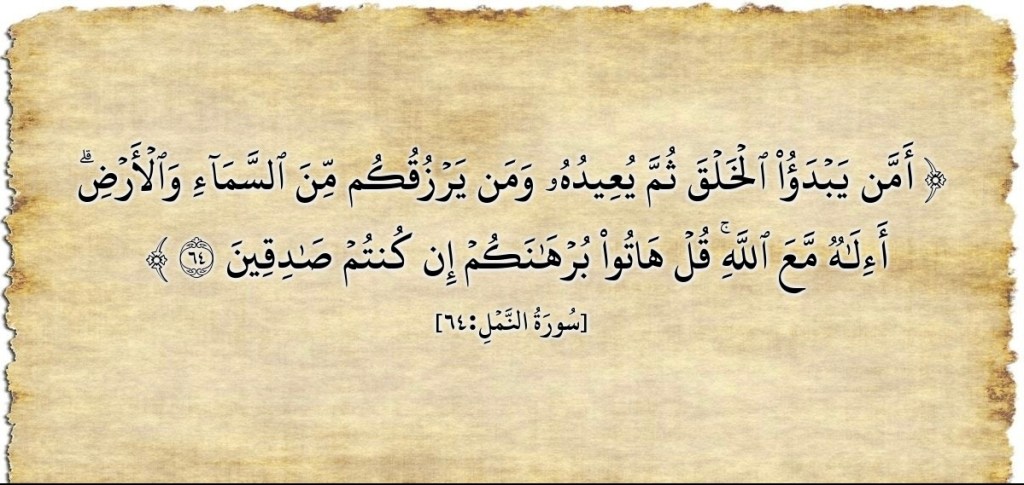
To this end the Quran repeatedly pushes the pre-Islamic Arabs to examine their belief so that they see the contradictions within and arrive at the correct conclusion. It accuses them of following their own whims and fancies (الظَّنَّ), demanding they produce your proof if you should be truthful (27:64)
The Quran sets out to awaken their rational faculty by drawing their attention to their own acknowledgement that Allah is the Creator and Owner of everything.
To whom belongs the earth and all that lives therein? [Tell me] if you know. (23:84)
They admit Allah is the Owner who has created the earth and all that exists on it. So, the Quran pushes them,
Will you not, then, reflect? (23:85)
Why do you worship these false gods when you admit that Allah is the Creator of all that exists?
Again, the Quran asks them:
Who is the Lord of the seven heavens, and the Lord of the Supreme Throne? (23:86)
Once again they answer correctly. Allah is the Owner and Ruler of the seven heavens and the Lord of the Mighty Throne. So the Quran rebukes them,
Will you not, then, fear Him? (23:87)
Aren’t you afraid of rebelling against Him, the all-powerful, Lord of the Supreme Throne, who has control over all that is in the heavens, by worshipping such false gods?
And again, the Quran asks them:
In whose hand rests the sovereignty of all things, protecting all, while against Him there is no protection? [Tell me] if you know.’ (23:88)
Once more they accept that Allah is the Supreme Ruler who has power over all things, and from Whom there is no protection. So the Quran reproaches them,
Then how are you deluded? (23:89)
Why then are you so confused and misled? When you know and acknowledge Him to be the Creator, the Owner and the Supreme Ruler of all that is on earth and in the heavens, when you admit none can protect you against Him, then you know that He alone is worthy of worship. So who has bewitched you, into setting up partners with Allah and worshipping them?
The Quran also draws their attention to the fact that their idols, these false gods they worship, are weak and ineffective, incapable of any action that deserves worship:
People, listen to this parable: Those whom you worship instead of God do not have the power to create even a fly, even though all of them would come together for the task. If the fly was to snatch something from them, they would not be able to rescue it from the fly. How feeble are such worshippers and that which they worship. (22:73)
How can these gods who have absolutely no power in the heavens or on earth, who are so feeble that they are incapable of creating even a lowly creature like a fly, who are so powerless that they cannot even protect the offerings which the worshippers bring them daily from being robbed by these flies, be partners of Allah, the Lord of the Supreme Throne. Think!
The Quran time and again underlines the importance of the intellect. Consequently, Islam makes it compulsory that every Muslim should arrive at belief (Iman) in the existence of the Creator by contemplation and reflection so as to ensure that man only worships the One worthy of worship. To this end we find the Quran repeatedly addressing the mind, calling on it to observe and ponder on the creation of Allah so that belief in His existence is based on conclusive evidence. There are countless ayats in the Quran that draw our attention to the heavens and earth, the sun and the moon, the creation of any one of us in our mother’s wombs, even laughter and tears for this very purpose.
Have We not made the earth as a bed, And the mountains as pegs? And We have created you in pairs, And have made your sleep as a thing for rest. And have made the night as a covering, And have made the day for livelihood. And We have built above you seven strong (heavens), And have made (therein) a shining lamp, And have sent down from the rainy clouds abundant water. That We may produce therewith corn and vegetations, And gardens of thick growth. (78:6-16)
And that it is He (Allah) Who makes (whom He wills) laugh, and makes (whom He wills) weep; And that it is He (Allah) Who causes death and gives life; And that He (Allah) creates the pairs, male and female, From Nutfah (drops of semen male and female discharges) when it is emitted…(53:43-46)
The Quran demands that conviction in the Creator come through looking and thinking deeply upon the creation of Allah so that Iman in Him is absolutely certain (یقین); know that there is no God except Allah (47:19)
In like manner, all the other concepts of Islam, be it belief in the messengers, the books, the angels, the Last Day, or al qadr must also depend on the mind and be based on clear proof. The use of the intellect and having rational evidence to support what we believe, leads to firm conviction and it is this conviction in the aqeedah of Islam that makes it a control for a Muslim’s conduct and what motivates him in his worldly life. On the other hand, if the aqeedah is not based on the intellect and clear evidence but is inherited or taught prescriptively, then it will not give rise to consistent behaviour. In fact it will be easy for Muslims to be affected by many conflicting thoughts and emotions.
We see that the Makkan portion of the Quran is predominantly concerned with belief. For 13 years the Prophet (SAW) taught his followers not only what to believe but also how to arrive at belief.
Jundub ibn Abdullah reported: We were with the Prophet, peace and blessings be upon him, while we were strong young boys. We learned Iman before we learned the Quran…
The Prophet (SAW) used this rational process to teach Iman to his followers, for this is the method of the Quran. His (SAW) utmost care for the Aqeedah and its motivational power is what transformed his followers into remarkable personalities, the Sahabah (ra).







 alqalamblog.com