
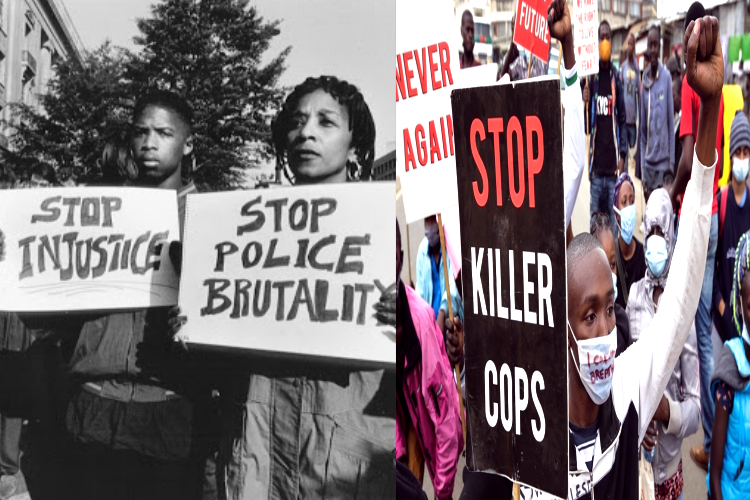
‘…Whoever heard of a sociological explosion that was done intelligently and politely? And this is what you’re trying to make the Black man do. You’re trying to drive him into a ghetto and make him the victim of every kind of unjust condition imaginable. Then when he explodes, you want him to explode politely!’ (Malcolm X at the London School of Economics, Feb. 11, 1965)
With the recent ‘race riots’ in America, sparked by the killing of George Floyd, being compared to the ‘long, hot summer riots of the 1960’s’, I felt compelled to re-read the autobiography of Malcolm X.
Perhaps I was looking to be reminded…how a country that advocates to be the champion of justice and upholder of human rights, can have a long history of racial injustice.
Malcolm X’s autobiography is not only his life story, but a social and political indictment against the American system of life.
Even at four years old Malcolm X, is aware of racism. His ‘earliest vivid memory’ is of
‘ being suddenly snatched awake into a frightening confusion of pistol shots and shouting and smoke and flames. My father had shouted and shot at the two white men who had set the fire and were running away. Our home was burning down around us…I remember we were outside in the night in our underwear, crying and yelling our heads off. The white police and firemen came and stood around watching as the house burned down to the ground…After the fire, I remember that my father was called in and questioned about a permit for the pistol…’ (The Autobiography of Malcolm X)
Though he grows up in the north of America considered to be ‘free’ in contrast to the ‘unfree’ South, nothing could be further from the truth.‘I am a creation of the Northern white man and of his hypocritical attitude toward the Negro,’ he said
The north already had desegregated lunch counters, desegregated parks and theatres, desegregated public toilets. As Malcolm X mocked,
‘you can sit down next to white folks on the toilet. Imagine that!’
But though the blacks had equality on paper, due to the color of their skin they could go just so far and no further. They lived, hemmed in central cities, in ghettoes (think shanty towns in third world countries), because the white man did not want to live next door to them; filthy ghettos where their babies were in danger of being bitten by rats; theoretically they could go to a white man’s restaurant, but they had no money for a meal in a white man’s restaurant; their people died daily from ‘that dreadful needle- heroin, morphine, cocaine, opium.’
Malcolm X came to be known as ‘the angriest black man in America’ for exposing the true face of American capitalism. ‘I would become so choked up, he said, that sometimes I would walk in the streets until late into the night. Sometimes I would speak to no one for hours, thinking to myself about what the white man had done to our poor people here in America.’ He was committed to telling the truth, ‘speaking as a victim of this American system’, so that his people could know who the enemy was in their struggle for dignity.
‘Twice as much rent is paid for rat-infested, roach-crawling, rotting tenements. This is true. It costs us more to live in Harlem than it costs them to live on Park Avenue…And in Harlem you have everything else in that apartment with you—roaches, rats, cats, dogs…’ (OAAU Founding Rally June 28 1964)
‘ And the white merchants charge us more money for food in Harlem—and it’s the cheap food, it’s the worst food; and we have to pay more money for it than the man has to pay for it downtown.’ (After the firebombing February 14 1965)
The majority of blacks were either underemployed, ‘doing the dirtiest jobs for the lowest pay’, or unemployed, forcing many people into a life of crime. The ghetto was a place of pimps and prostitutes, drug pushers and addicts. A place of black on black crime, white hostility, and police brutality. ‘I think that an objective reader may see how in the society to which I was exposed as a black youth here in America, for me to wind up in prison was really just about inevitable.’ Malcolm’s description of his life in the ghetto shows what white society did (and still does) to those who are its black victims.
His book unmasks an inhumane and intolerant society that ‘will crush people and then penalize them for not being able to stand up under the weight.’ A society for whom integration meant ‘tokenism’ – ‘one or two negroes in a job, or at a lunch counter, so the rest of you will be quiet’ or ‘ handouts in the form of appointments that are only used as window dressing to make it appear that the problem is being solved.’
Not surprisingly, he persistently warned of the imminent explosion of ‘America’s racial powder keg.’ Malcolm X could see that the new generation of blacks were fed up of ‘turn the other cheek and heaven after you die philosophy.’ He counseled that the black man had a right to protect their women and children in the face of increasing white attacks; they had a right to their basic necessities right here on earth, rather than look to heaven for a better life. He saw it as a ‘miracle’ that 22 million black people ‘have remained a peaceful people, while catching all the centuries of hell that they have caught, here in white man’s heaven!’ They were impatient with police dogs and clubs, with water hoses and tear gas. They had had enough with the lynching, the abuse, the exploitation, enough with the lack of respect and dignity. ‘And in this country the black can be fifty years old and he is still a “boy.” In this society we remain ‘boys’.
‘1964 will be America’s hottest year; her hottest year yet; a year of much racial violence and much racial bloodshed. But it won’t be blood that’s going to flow only on one side. The new generation of black people that have grown up in this country..are already forming the opinion…that if there is to be bleeding, it should be reciprocal-bleeding on both sides…Negroes have done nothing but seen each other turn the other cheek. This generation won’t do it, won’t do it any longer…
An example of this was taking place last night at this same time in Cleveland, where the police were putting water hoses on our people there and also throwing tear gas at them—and they met a hail of stones, a hail of rocks, a hail of bricks. Now, Negroes didn’t do this ten years ago… The seriousness of this situation must be faced up to. You should not feel that I am inciting someone to violence. I’m only warning of a powder-keg situation…’ (The Black Revolution April 8 1964)
Malcolm X understood that the oppression his people were subjected to and were rising up against was not because of a few bad apples, but was systematic, grounded in the makeup of the American political, economic and social order. ‘You can’t have capitalism without racism’; ‘you have to have someone else’s blood to suck to be a capitalist.’ He argued that the system could not produce freedom and equality for Black people, in the same way that a ‘chicken can never lay a duck egg’. The best the Afro-American could hope for was ‘token integration’, where a lucky few did well but the masses were locked out.
‘A man or system which oppresses a man because of his color is not moral…It’s the system that is rotten; we have a rotten system. It’s a system of exploitation, a political and economic system of exploitation, of outright humiliation, degradation, discrimination—all of the negative things that you can run into, you have run into under this system…’ (OAAU founding Rally June 28 1964)
‘And there is no system on this earth which has proven itself more corrupt, more criminal, than this system that in 1964 still colonizes 22 million African-Americans, still enslaves 22 million Afro-Americans.’ (The Black Revolution April 8 1964)
He concluded that the only way out was ‘black nationalism’. He urged blacks to unite and separate themselves completely from whites, so that they could either return to their African homeland or build a separate black nation in the Western Hemisphere.
However, when he journeys to Makkah for the Hajj pilgrimage and becomes a Muslim, Malcolm X sees that there is a way the black and white man can live together on earth. He realises there is a ‘proven solution’,
‘America needs to understand Islam, because this is the one religion that erases from its society the race problem.…Throughout my travels in the Muslim world, I have met, talked to, and even eaten with people who in America would have been considered ‘white’— but the ‘white’ attitude was removed from their minds by the religion of Islam. I have never before seen sincere and true brotherhood practiced by all colors together, irrespective of their color.’
What he had been searching for, for his people, for them to be respected as human beings, for them to have access to basic material needs, for them to have a right to education and employment, he found to be an inalienable right of all in Islam. Islam spoke to the whole person – to the economic, social, political and spiritual wellbeing of not only blacks, but of every human being.
How does Islam speak to the whole person?
The system of life that Allah (SWT) has chosen for man ensures justice and dignity of all mankind. Allah (SWT) sent Prophet Muhammad (SAW) ‘as a mercy to the worlds’ (21:107); a mercy because he brought a law that taught humans how to live harmoniously with each other. The Prophet (SAW) founded a state in Madina on these revealed laws, and as Islam spread, the Islamic State managed to meld and unite people of various nations, colors, and religions.
Managing people with all their differences and complexities did not constitute a problem for the Muslim Ummah as it was guided by the Book and Sunnah of Allah (SWT).
Allah teaches us that regardless of our skin colours and physical traits, inspite of the diversity of our cultures and languages, we are all the children of Adam. He (SWT) has ‘created you from one soul (Adam), and from him, He created his wife (Hawwa), and from them both He created many men and women’ (4:1). Allah also tells us that ‘We created man out of an extract of clay (water and earth), then We made him as a Nutfah (mixed drops of the male and female sexual discharge) (and lodged it) in a safe lodging (womb of the woman); then We made the Nutfah into a clot, then We made the clot into a little lump of flesh, then We made out of that little lump of flesh bones, then We clothed the bones with flesh, and then We brought it forth as another creation. So blessed be Allah, the Best of creators’ (23:12-14). And we come in different colours because,
‘Verily, Allah Almighty created Adam from a handful which He took from the earth, so the children of Adam come in accordance with the earth. Some come with red skin, white skin, or black skin, and whatever is in between: thin, thick, dirty, and clean.’ (tirmidhi)
Allah has even informed us that He has divided us into nation and tribes ‘so that you may know one another’ (49:13); so that we can cooperate and help each other to meet all our various needs.
All of this human diversity is in fact a sign of Allah’s existence and power; and can not be taken to mean that a particular nation or color is superior or inferior. The Prophet (SAW) has clarified to us,
‘An Arab is not better than a non-Arab and nor a non-Arab is better than an Arab, and a White man is no better than a Black man, nor a Black man is better than a White man…’ (Ahmad)
Rather Islam teaches that superiority is only on the basis of God consciousness; ‘Indeed, the most noble of you in the sight of Allah is the most righteous of you’ (49:13), for ‘verily, Allah does not look at your appearance or wealth, but rather He looks at your hearts and actions.’ (Muslim)
It was this concept and Islam’s insistence on equality of every member of the human race, the ‘colour blindness’ of the Muslim world, that revolutionalized the way Malcolm X thought. He was shocked when he went to Makkah and saw pilgrims who ‘were of all colors, from blue-eyed blonds to black skin Africans…displaying a spirit of unity and brotherhood that my experiences in America had lead me to believe never could exist between the white and non-white.’ He moved away from seeing the white man as ‘inherently evil’, to understanding that ‘it’s the American political, economic and social atmosphere that automatically nourishes a racist psychology in the white man.’ Sadly today we see the Muslim world becoming more and more divided along these divisive lines as a result of our capitalistic economies.
Allah’s laws do not only deliver social justice but economic justice too. Allah tells us that He (SWT) has ‘honoured the Children of Adam…and exalted them above many of Our other creatures’ (17:70), so Islam seeks to maintain man’s dignity by providing a satisfactory standard of living for every individual. Because how can man, the noblest creation of Allah, whom Allah has ‘exalted’, satisfy his spiritual yearnings and his intellectual abilities, if he spends his whole life worrying about making ends meet? Such a society, where people are not able to earn a sufficiency, is disobedient to the will of Allah.
So the Islamic economic system seeks to secure the basic needs- food, clothing and shelter- completely of every single citizen of the Islamic State. The Prophet (SAW) said ‘the son of Adam has no better right than that he would have a house wherein he may live, a piece of clothing whereby he may hide his nakedness and a piece of bread and some water’ (tirmidhi)
The State does this by providing job opportunities so that every capable person can work and acquire the basic needs for himself and his dependents, ‘He it is Who has made the earth subservient to you; so walk in the paths thereof and eat of His provision’ (67:15), and the Prophet (SAW) said, ‘No meal eaten by one of you is better than the meal he eats from the work of his own hands. (bukhari)
For those who cannot earn or whose families cannot provide for them, it is the State’s responsibility- ‘the ruler is the supporter of he who has no supporter’ (abu Dawud)- to provide for them from the Zakat in order to fulfil their bodily needs and preserve their dignity. Through the payment of Zakat, which Allah has made obligatory on all those who possess wealth that they should pass on to the needy some part of it, ‘And those in whose wealth there is a known right, For the beggar and the destitute’ (70:24-25), Islam achieves not only an equitable distribution of wealth ( ‘So that this wealth should not become confined only to the rich amongst you’ (59:7), but also fosters a sense of harmony amongst the members of society.
Islam ensures these social and economic rights are upheld by both relying on the system of law and appealing to the human conscience. The Prophet (SAW) has told us that ‘the Imam (ruler) is a guardian and is responsible for his subjects’ (bukhari), so it is his duty to make certain that all citizens, including non-muslim citizens, are granted their rights and live in a just society. Allah (swt) says,
‘And if you judge, judge with justice between them. Verily, Allah loves those who act justly.’ (5:42)
‘O you who believe! Stand out firmly for justice, as witnesses to Allah, even though it be against yourselves, or your parents, or your kin, be he rich or poor…'(4:135)
At the same time Islam appeals to the human conscience making it responsible for complying with all laws and duties ordained by Allah. The Quran and injunctions of the Prophet (SAW) foster a firm conviction that Allah sees all and knows all ‘Fear Allah for Allah knows the very secrets of the hearts’ (5:7), instilling in the believer the belief that he is accountable for his actions, an accounting that will lead to heaven or hell.
The Islamic system of life is not from the minds of men, rather it is from the Creator of all Mankind. A man made system of life will no doubt lead to the oppression of people. Only a system from the Creator, who knows all the rights that man is entitled to and how these rights should be administered, can provide justice for all. Is it any surprise than that Malcolm X said, Islam ‘is the one religion that erases from its society the race problem.’
 alqalamblog.com