
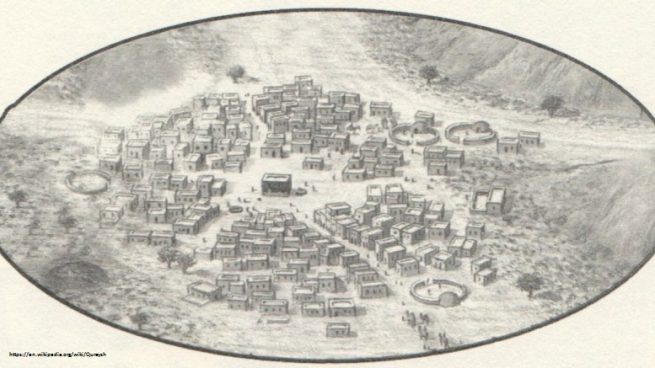
Arabia was a wretched place prior to the advent of Islam. As Jaffer bin Abi Talib told the Najashi of Abyssinia, the Arabs before Islam ‘were plunged in the depth of ignorance and barbarism.’
There was no state and no government. Instead Arabia was inhabited by innumerable tribes. The Arabs recognized no ruler and no law. They only acknowledged the authority of their tribal chiefs. Might was always right and the only protection lay in belonging to a tribe. Assabiyah, unconditional loyalty to your clan, whether they were right or wrong, oppressed or oppressor, was a way of life.
Tribal warfare was the norm. In fact the Arabs courted war, and were consumed by vendattes and counter vendettas.
It was a place of economic inequality: the practice of usury (riba) had made the rich richer and the borrowers poorer. It was also a highly class conscious society. Tribal heads, traders and merchants formed the elite, while the majority of the tribe members were poor, with the slaves occupying the lowest strata of society.
Women were oppressed. They had few rights when it came to marriage, divorce, children, and inheritance. In fact some Pre-Islamic Arabs felt such shame at the birth of a daughter that they would bury her alive.
Drinking, gambling, and promiscuity was widespread.
The dominant religion in Arabia was idol worship. The Arabs supplicated, prostrated, and sacrificed to gods made of stone.
They were a deeply superstitious people who believed in omens- certain days, months, and animals were thought of as good or bad. They would frequent soothsayers and astrologers believing they could foretell the future.
It was against this backdrop, that Allah (SWT) honoured Mohammad (saw) with prophet-hood and commanded him to convey to his people,
‘Worship Allah (alone) and keep away from the taghut (false gods).’ (16:36)
And many Arabs heard what Mohammad (saw) proclaimed and embraced Islam.
These new Muslims would gather in Dar al Arqam where the Prophet (saw) would ensure they arrived at Iman in the correct manner. They were encouraged to contemplate the reality around them, to observe its limits and dependency, and from this conclude that the universe and everything in it had a Creator, and He is Allah. They heard the Quran and concluded it to be the word of God for it rendered them, the masters of the Arabic language, incapable of meeting its challenge and so they were certain that the one who brought the miracle was who he said he was, a Messenger of Allah. They were guided by the Quran and under the tutelage of the Prophet (saw) to build their belief upon the mind and evidence.
Likewise they were guided to seek answers to man’s most fundamental questions that occur inevitably and trouble every man: How did I get here? Why am I here? What follows after this life? They found that the Islamic Aqeedah answered these questions conclusively and convincingly: This universe has a creator that created it and everything in it, and He is Allah. He (SWT) sent Prophet Mohammad (saw) to convey to them the meaning of their existence and how they should proceed in the whole of life. This life has a beginning and an end, after which there will be an accounting of deeds.
They were intellectually convinced of the truthfulness of the Aqeedah and it inspired these Arabs, the Sahabah of Rasool Allah (saw) to renounce the ‘blind’ beliefs and practices of their society, and to mould themselves into personalities that pleased Allah. It was this firm belief that motivated them to support the Prophet (saw) in his mission of trying to change the dominant thoughts held by Makkan society to those of Islam so as to establish the rule of Allah. They persisted in this despite the torture and suffering inflicted on them by the Quraysh, seeking only to please Allah.
Men like Mus’ab ibn Umair of whom the Prophet (SAW) said,
‘I saw Mus’ab here, and there was no youth in Makkah more petted by his parents than he. Then he abandoned all that for the love of Allah and His Prophet!‘
who grew up in the lap of luxury, was a fashion icon of his time, and the pride of Quraysh, but who renounced it all for the pleasure of Allah. When his mother heard he had become Muslim, she had him chained and imprisoned in their house, and subsequently disowned him. Mus’ab, however, did not waver.
Men like Bilal ibn Ra’bah whose slave master Umaiya bin Khalaf had him thrown on to the scorching desert sand at the hottest time of the day and kept him down by pacing a heavy rock on his chest. It was said to him,
‘Your gods are lat and Uzza so testify your faith in them’
But Bilal’s belief in Allah was so certain, that although he had no rights and no wealth, was in fact himself property, he endured. His reply was simply,
‘Ahad. Ahad’ (God is one)
Women like Sumayyah bint Khayyat, a freed slave, who despite being old and frail was tortured and beaten. When the Prophet (saw)saw her and her family being tortured, he (saw) comforted them with the words,
‘Your reward is Jannah.’
Sumayyah’s reply was, ‘I can see it, O Messenger of Allah.’
She refused to abandon Islam and paid for it with her life, becoming the first martyr in Islam.
Women like Ramlah bint Abu Sufyan, (Umm Habiba), who was the daughter of Abu Sufyan, the leader of Quraysh and a fierce opponent of Islam. In order to practice her deen freely, she choose to give up her luxurious life and migrate to Abyssinia, where her husband renounced Islam and became a Christian. Despite being in a foreign country, Umm Habib, wanting to hold onto her deen, divorced him and chose not to return to her father’s house.
This belief in Allah transformed a group of unremarkable men and women into the Sahabah of Rasool Allah (saw) who were willing to sacrifice their life, wealth, time and desires for Allah’s sake for
‘Indeed Allah has bought from the Believers their persons and their possessions in return for the Gardens’ (9:111);
men and women who when they recited ‘La illaha ilAllah’ understood the commitment and responsibility it would demand of them, and who remained true to the pledge they made with Allah.
‘Among the believers are men true to what they promised Allah. Among them is he who has fulfilled his vow [to the death], and among them is he who awaits [his chance]. And they did not alter [the terms of their commitment] by any alteration.’ (33:23)
 alqalamblog.com