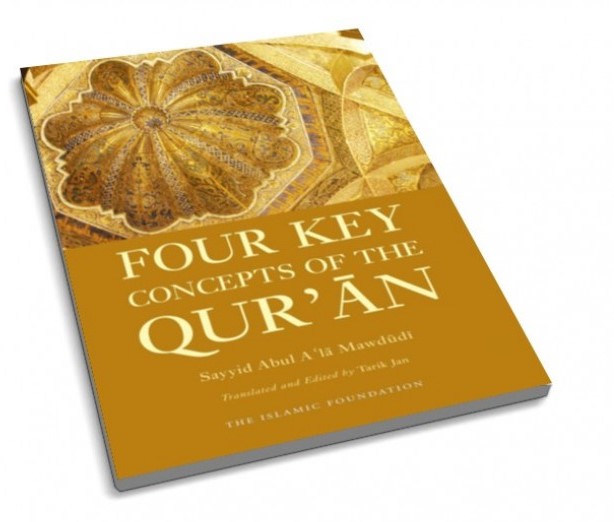
On and off I keep dipping into Sayyid Abul A ‘la Mawdudi’s ‘Four Key Concepts of the Quran’. I find the book to be quite enlightening as Mawdudi goes to great lengths to explain the meaning of four key concepts found in the Quran: Ilah, Raab, Ibadah, and Deen.
He clarifies that over time a decline in interest in the Arabic language, has led to subtle changes in how these terms have come to be understood. So today we do not understand them in the same manner as the original Arabs did, rather our grasp is restricted and vague.
So today,
Ilah means false gods or idols
Rabb means the Provider and Sustainer
Ibadah means ritualistic worship
Deen means religion
Mawdudi demonstrates that the Arabs, to whom the Quran was revealed, who knew their language well, understood the correct and full implication of these words. Those who accepted the call understood the change it sought to bring in their lives and what they had to discard in order to embrace the call, while those who rejected the call knew full well the implications of their failure to defeat it.
In his book, Mawdudi, attempts, with the support of Quranic ayats, to convey the complete significance of these terms so that we can correctly understand the message of the Quran.
He explains that the Arabic dictionary defines Ilah as that which is worshipped, and carries a host of connotations such as the one who is all powerful and exalted, the one who is the provider, protector and comforter, the one who is concealed from the senses and has a mysterious presence.
Mawdudi maintains that the pagan Arabs and past nations mentioned in the Quran, believed in the existence of a Supreme Ilah whom they called ‘Allah’. Their deviation lay in the fact that they believed others – idols made of stone and wood, angels, jinn and saints- had some share in the Supreme God’s Divinity. So they would made dua and offerings to these false gods thinking them to be capable of interceding on their behalf with Allah. This intervention they believed could result in some worldly benefit or ward off some harm.
Mawdudi elaborates that the Quran also uses this same word ilah when it refers to the Pagan Arabs following the orders of their own selfish desires, or of other human beings, such as their tribal chiefs and family elders, without caring to ascertain God’s rule on the matter. These ilah’s are in no way divine; no prayers or sacrificial offerings were offered to them, but the Quran nevertheless imparts divinity to them. They are ‘ilahs’ in the sense that they were looked upon as having the right to decide what was halal and haram, and what they dictated was accepted.
The Quran challenges this whole concept of ilah and makes clear that Allah is the only ilah. It asserts that Godhead can not be split and distributed, and Allah must be regarded as the only ilah in all the different meanings of the word. ‘Take not two ilahs in worship; He is but one ilah…’ (16:51)
Mawdudi elaborates that the Quran makes clear that there is only One Being in the heavens and on earth who possesses all power and authority. All creation is His and is bound by laws made by Him. Thus He alone has the power to alleviate hardship, listen to our prayers, grant us good and protect us from harm. Moreover, since everything owes their existence to Him and He is the sustainer and manager of all life, than He alone has the right to dictate what is right and wrong, halal and haram for the whole of creation. This is all part of Godhead and no one, for they all owe their existence to Him, can lay claim to any part of it.
Likewise, he explains that the word Rabb too has a wide range of meanings. It signifies the one who is the owner and master, the one who nourishes, rears and sustains, the one responsible for improving a situation, the one who is the sovereign, whose word is obeyed, and the one who occupies a focal position.
Mawdudi again stresses that the past nations who strayed did not deny that Allah was the Rabb. But as they had done with regards to the concept of ‘ilah’, they split and distributed its various connotations among the creation of Allah. Consequently they believed others -angels, celestial bodies, man-made gods, spirits, saints, or prophets- shared in Allah’s Rububiyah (qualities and attributes of one who is Rabb) and hence had the power to grant and protect. They refused to discard these other false gods whom they had elevated to the status reserved only for Allah, and so they refused to accept Allah as the Ilah and Rabb who alone deserved worship. Moreover, they took their chiefs, tribal elders, or religious clergy, as lawmakers allowing them to decide what was good or bad for them; believing they had no need for Divine guidance in running their worldly affairs. Allah sent prophets to correct their understanding; prophets who all stressed that what they ascribed to others was the exclusive right of Allah. Mawdudi highlights repeatedly that rububiyah is not divisible, ‘The Quran projects al- Rabb as an Absolute Sovereign with none to share His ownership and governance.’
We than learn that the word ibadah also has several meanings: slavery, bondage, submission, obedience and to show gratitude to the master for his favors. The pre-Islamic nations were quilty of making ibadah to their false ilah’s, be it in the form of ritualistic worship such as supplicating or praying to them or offering them sacrifice, or of accepting these false ilah’s had the right to lay down laws for regulating society. The Quran proclaims all these objects of worship and their ibadat to be wrong. Allah alone is the Lord of all that exists, He alone deserves to be worshipped and so all ibadah must be reserved exclusively for Him.
Mawdudi asserts that Muslims must understand ibadah to encompass all aspects of life whether spiritual or societal, and not just in the ritualistic sense of performing the five daily prayers, fasting, giving Zakat and performing Hajj. It points to a Master and slave relationship, wherein the Master has to be consulted prior to any action.
Lastly, Mawdudi explains the word deen, which also had several connotations among the Arabs. It meant supreme authority, obedience to that authority, laws imposed by that authority, accountability and reward or punishment meted out by the authority. He, however, notes that the word had not attained the status of a formal term until the advent of the Quran.
The Quran makes use of the word in all the varied ways the Arabs employed it, but it also uses deen as a term that comprehensively encapsulate all these various meanings to convey a whole way of life. Mawdudi notes that the Quran equates deen with a system of life wherein man accepts someone as having the ultimate authority and agrees to live by the laws laid down by that authority, hopeful of receiving benefit for complying with the law while fearful of punishment for not. If the laws that man lives by are from Allah than they are in His deen; but if governance belongs to a man-made system, be it a monarch, a priest or a scholar, and people accept that authority than they are followers of that authority’s deen. The Quran makes clear that Islam is the only true deen. Allah is the sole Sovereign, the only One who has the right to lay down rules and laws by which humans live their lives. No other system is acceptable to the Lord of the Universe.
Mawdudi illustrates with ayats from the Quran that deen encompasses more than ritualistic worship. It is an all embracing life system that covers belief, thoughts, rituals, morals, as well as all social, financial, and political aspects of life. He observes that it is difficult to find a word in any language that captures all the meanings summed up by the word deen. According to him, the closest word to deen, would be ‘a state’ meaning a system of governance, and even this word fails to do full justice.
Mawdudi stresses that our corrupted understanding of these terms has made the ‘Quranic intent obscure and difficult to understand’, resulting in obvious flaws in our belief and practices. He warns a person ‘may continue saying la ilaha illAllah – there is none but Allah- and still elevate a multitude of people and philosophies to divinity’ and it is important that these ‘primary concepts’ be fully explained so that we correctly grasp the concept of tawheed and shun its opposite shirk.
 alqalamblog.com